
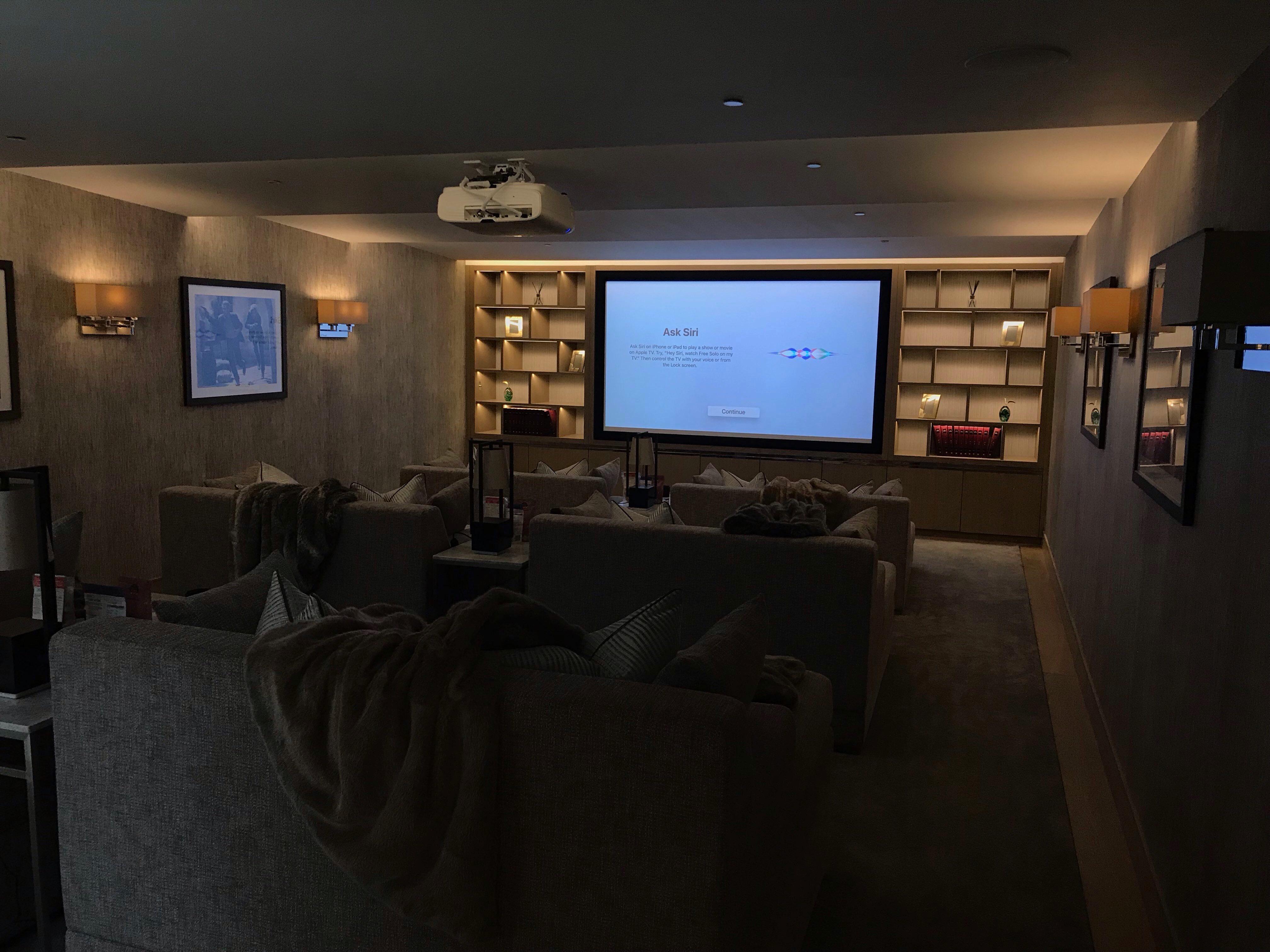
Luxury Home Cinema Installation in London
Private theatres and home theatre design for London properties
London's Premier Cinema Installers and Designers
Home cinema installation from £15,000+
We have built private cinemas across London for over a decade, from basement conversions beneath Chelsea townhouses to penthouse media rooms overlooking the Thames and dedicated cinema suites in Hampstead villas. Increasingly it also means a building outside the main house, and our garden cinema room guide sets out the structure, acoustics, power and planning that route involves. London is not an easy city in which to build one. Space is limited, neighbours are close, buildings are old and regulations are strict. Those constraints are exactly why we survey each room to the millimetre, analyse how sound travels through the existing structure, and coordinate with your wider smart home installation London and lighting control plans from the very first survey.
The starting point for any London cinema project is a meticulous site survey. We measure room dimensions to the millimetre, analyse existing construction to understand sound transmission paths, assess electrical capacity for projector and amplifier loads, and evaluate ventilation options for heat management. In listed properties, we consult with conservation officers to ensure our proposals respect historic fabric. In leasehold apartments, we review building regulations and service agreements that may restrict noise levels or structural modifications. This thoroughness prevents surprises and ensures your cinema is designed for reality, not fantasy.
Acoustic design is where our London expertise truly shines. In a detached country estate, sound isolation is relatively straightforward. In a Kensington townhouse with neighbours on both sides, it is an engineering challenge. We employ multi-layer construction techniques: resilient channel ceilings that decouple the cinema ceiling from the floor above, mass-loaded vinyl barriers in walls that add density without bulk, and floating floors that isolate subwoofer vibrations. Our acoustic treatment inside the room includes calibrated absorption and diffusion panels that tame reflections while preserving the spaciousness that makes cinema audio immersive. Every panel is positioned based on ray-tracing analysis of speaker dispersion patterns.
Projection technology selection depends heavily on your room. For compact London basements with limited throw distance, we specify ultra-short-throw or short-throw projectors that deliver 100-inch images from just 1.5 metres. For larger dedicated cinema rooms, native 4K projectors from Sony and JVC provide reference-quality images with HDR, wide colour gamut and exceptional contrast. Every projector we install is ISF-calibrated for colour accuracy, gamma and white balance, ensuring the image you see matches the filmmaker's intent. We also install motorised projector lifts that recess the projector into the ceiling when not in use, essential for multi-purpose rooms where aesthetics matter.
Audio design follows the same rigorous approach. We specify speaker configurations based on room dimensions and listening position, from compact 5.1 systems in small rooms to immersive Dolby Atmos arrays with ceiling speakers in dedicated cinemas. Speaker selection balances performance with discretion: in-wall and in-ceiling models from KEF, Artcoustic and Wisdom Audio deliver exceptional sound while remaining virtually invisible. Subwoofer placement is determined through room mode analysis to minimise standing waves and deliver smooth, powerful bass. We calibrate every system using professional measurement microphones and Dirac Live or Trinnov room correction, ensuring the audio response is flat, balanced and immersive.
Seating and environment complete the cinematic experience. We supply tiered cinema seating from leading manufacturers with motorised recline, heating, cooling and USB charging. Sightline analysis ensures every seat has an unobstructed view of the screen. Smart lighting creates programmable scenes: a Welcome scene that illuminates steps and aisles, a Pre-Show scene that dims gradually over 5 minutes, and a Cinema scene that extinguishes all light except subtle LED coves. Motorised blackout blinds eliminate daylight, and climate control maintains perfect temperature regardless of projector heat or audience size.
Control integration ties everything together. A single button press on your Control4 or Crestron remote can lower the projector, close the blinds, dim the lights, set the amplifier to reference level and start your selected film. For Kaleidescape movie server owners, the system can even display cover art on a secondary screen while cueing the main feature. Our London clients consistently tell us that the moment of pressing that Cinema button, watching their room transform in 45 seconds, is worth every penny of the investment. It is the difference between watching a film and experiencing cinema.
What We Deliver
4K Projection & Display
Sony, JVC and Epson native 4K and laser projectors with ISF calibration, acoustically transparent screens and motorised lifts.
Dolby Atmos Audio
Immersive 3D surround sound with Wisdom Audio and Artcoustic speakers, ceiling channels and professional room correction.
Acoustic Engineering
Bespoke absorption, diffusion and bass trap treatment with party wall isolation for terraced and semi-detached homes.
Projector Lifts
Motorised ceiling recess systems that hide projectors completely when not in use, preserving room aesthetics.
Tiered Seating Design
Custom seating layouts with sightline analysis, motorised recline and integrated heating for optimal comfort.
Cinema Lighting Scenes
Programmable LED coves, step lighting and aisle markers with automated dimming sequences.
One-Touch Control
Single button activation of projector, screen, audio, lighting, blinds and climate through Control4 or Crestron.
Home Theatre Design
Detailed acoustic modelling, 3D visualisation, technical drawings and equipment specification before construction begins.
Smart Integration
Cinema scenes that integrate with whole-home automation, alarm, CCTV, climate and lighting systems.
What a London Home Cinema Costs
Almost every London cinema we build lands in one of four brackets. These are installed prices: design, equipment, acoustic treatment, programming, calibration and commissioning are all included. Each bracket is opened up line by line in our home cinema cost guide, which separates the equipment from the construction and the calibration.
A 100-inch screen, 5.1 audio, blackout blinds and programmed lighting scenes in a spare room or garden office.
Native 4K projection, 7.1 or Dolby Atmos audio, acoustic treatment, tiered seating and one-touch control.
4K Cinematic playback, full party-wall isolation, bespoke joinery and a Kaleidescape server.
Basement excavation, structural work, cinema-grade ventilation and multi-room Kaleidescape distribution.
Room size, acoustic isolation and construction work move the figure more than the projector does. Our full home cinema cost guide breaks down component pricing, tiered budgets and the costs that catch people out.
Read the full cost guideBuilding outside the house is often the cheaper route, because a detached garden room shares no structure with anything and does not need party-wall isolation. Our guide to the garden cinema room covers the building itself: structure, acoustics, power, network, planning limits and what each option costs.
Garden cinema room guideHome Theatre Design Services
A great home theatre starts with great design. Before a single cable is run or speaker is mounted, every aspect of the room must be analysed, modelled and planned. Our home theatre design service provides the architectural and technical foundation for private cinemas that deliver a truly cinematic experience. We produce detailed drawings, equipment schedules, acoustic models and 3D visualisations that ensure your theatre is built right the first time. If you are weighing those decisions up yourself before committing to a design fee, our home cinema room design guide works through screen wall choice, seating distance, projector throw and treatment positions in the order they need to be settled.
The design process begins with understanding your vision. Do you want a traditional cinema with red velvet seats and a concealed projector, or a contemporary media space with minimalist aesthetics and visible technology? Will the room be used exclusively for films, or also for gaming, sports and music? How many people should it seat? What is your budget range? These questions shape every decision that follows, from screen size to speaker selection to acoustic treatment strategy.
Room analysis is the technical foundation of our design work. We measure dimensions with laser accuracy, analyse surface materials for their acoustic properties, and assess construction type for sound isolation potential. Using specialised software, we model room modes: the natural resonances that occur at specific bass frequencies in enclosed spaces. This analysis identifies problematic frequencies that will require targeted bass trapping, and it informs subwoofer placement to ensure smooth bass response across all seating positions.
Speaker placement design follows established cinema standards modified for your specific room. We calculate optimal positions for left, centre and right speakers behind an acoustically transparent screen, surround speakers at precise angles relative to the listening position, and ceiling speakers for Dolby Atmos height effects. Every position is documented with distances, angles and mounting heights. For in-wall and in-ceiling speakers, we produce detailed builder instructions showing exactly where to create openings and how to isolate them from structural vibration.
Seating design combines ergonomics with sightline analysis. We specify tiered platforms that ensure every row has a clear view of the screen, with riser heights calculated from screen bottom edge to eye level. Seat spacing allows comfortable legroom and aisle access. We also specify acoustic treatment beneath seating platforms to prevent the hollow boom that occurs when subwoofer energy excites empty cavities. For luxury installations, we design bespoke seating with motorised recline, heating, cooling and integrated cup holders, working with specialist cinema furniture suppliers.
Lighting design creates the atmosphere that transforms a technical room into a cinematic space. We design concealed LED coves that provide subtle ambient illumination, step lighting for safe navigation in darkness, and programmable scenes that integrate with your control system. The Welcome scene illuminates the room at 50% for entry, the Pre-Show scene dims gradually over five minutes, and the Cinema scene extinguishes all light except subtle cove illumination at 2%. We also specify blackout solutions: motorised blinds, curtain tracks and light seals around doors to eliminate every source of external light. Every design is presented with 3D visualisations showing lighting effects, material finishes and furniture placement, so you can see your cinema before it is built.
London Areas We Serve
Equipment We Install
Kaleidescape Players and Terra Prime Servers
Where the source matters as much as the projector, we supply and install Kaleidescape. Films are downloaded rather than streamed, so a feature plays from local storage at full bitrate with no buffering and no drop in picture or sound quality. The Strato K, the current flagship, introduces the 4K Cinematic format at bitrates averaging around 110 Mbps and is the first movie player certified by the 8K Association.
A server is only as good as the network behind it. We design the switch, structured cabling and rack space as part of the cinema rather than as an afterthought, so a 4K Cinematic film downloads in about fifteen minutes over gigabit Ethernet. Control is integrated too, which means the same remote or keypad that dims the lights starts the film. Vertex AV is an authorised Kaleidescape dealer and a Control4 Pinnacle dealer.
Read the Kaleidescape guideWhat Kaleidescape is, what it costs in the UK, and which player suits which room, written by our own installers.
What we handle
- Strato K with 4K Cinematic, native 8K and Dolby Vision
- Strato V, E, M and C players matched to the room
- Terra Prime servers, scaling from one room to a whole house
- Control4, Crestron, Savant and Josh.ai integration
- Supply only, or supplied, installed and commissioned
Cinema FAQs
What makes home cinema installation in London different from elsewhere?
London properties present unique challenges for home cinema installation that demand specialist expertise. Space constraints mean we often work with compact rooms that require clever acoustic treatment and short-throw projection. Party wall regulations in terraced and semi-detached properties demand sound isolation solutions that prevent bass transmission to neighbours. Building regulations in listed properties restrict structural modifications. And many London basements suffer from damp and limited headroom, requiring specialised ventilation and projector lift solutions. Our London team has installed cinemas in virtually every property type the city offers, from basement conversions in Chelsea to penthouse media rooms in Canary Wharf.
How much space do I need for a home cinema?
You need less space than you might think. A compact cinema with a 100-inch screen and 5.1 surround sound can work in a room as small as 4 metres by 3.5 metres. A more expansive setup with tiered seating, a 120-inch screen and 7.1 Dolby Atmos audio ideally requires 6 metres by 4.5 metres or larger. We have designed effective cinema spaces in London mews houses with just 3.5 metres width, using ultra-short-throw projectors and acoustic treatment that maximises every centimetre. During your consultation, we measure your space precisely and design a system that delivers the best possible experience within your constraints.
How much does a bespoke home cinema installation cost?
Costs vary widely based on room size, equipment level and construction requirements. A compact media room with a quality projector, 5.1 soundbar-style system and basic lighting control might start around £15,000. A mid-range dedicated cinema with a 4K projector, 7.1 in-wall speakers, acoustic treatment and smart control typically ranges from £35,000 to £75,000. High-end installations with native 4K projection, Dolby Atmos immersive audio, tiered seating, comprehensive acoustic isolation and integration with a whole-home Control4 or Crestron system can exceed £150,000. During your consultation, we provide a detailed proposal with transparent itemised pricing so you understand exactly where your investment goes.
Do I need a dedicated room, or can any room become a cinema?
Any room can become a cinema with the right design approach, though dedicated rooms deliver the best results. Living rooms, family rooms and garden rooms can be converted into excellent media spaces using ambient-light-rejecting screens, soundbars or compact speaker systems, and motorised blackout blinds. Dedicated cinema rooms allow for full light control, comprehensive acoustic treatment, tiered seating and reference-grade projection without aesthetic compromise. We have converted spare bedrooms in Radlett, garden offices in Henley-on-Thames, and basement utility rooms in Wilmslow into stunning private cinemas. The key is matching the design to the room's constraints rather than forcing an inappropriate specification.
Which audio format should I choose: 5.1, 7.1 or Dolby Atmos?
The ideal format depends on your room size and content preferences. A 5.1 system, with front left, centre and right speakers plus two surround speakers and a subwoofer, delivers excellent cinematic audio in rooms up to 4.5 metres wide. A 7.1 system adds two rear surround speakers for enhanced envelopment in larger rooms. Dolby Atmos adds overhead or height speakers that create a three-dimensional soundfield where helicopters fly overhead, rain falls from above, and ambience surrounds you completely. For dedicated cinema rooms over 5 metres wide, we strongly recommend Dolby Atmos with at least four ceiling channels. All formats benefit enormously from proper room calibration, which we perform using professional measurement equipment to ensure every channel is perfectly balanced.
What acoustic treatment do you install?
Acoustic treatment is essential for any home cinema, and we design bespoke solutions for every room. Our installations typically include broadband absorption panels on the rear and side walls to control first reflections, bass traps in corners to manage low-frequency build-up, and diffusion panels on the rear wall to create a spacious, enveloping soundfield. In London properties with party walls, we add mass-loaded vinyl barriers and decoupled studwork to prevent sound transmission. Ceiling treatment addresses vertical reflections, and a carpet or acoustic underlay absorbs floor reflections. Every treatment is specified based on room dimensions, speaker placement and listening position, with 3D acoustic modelling used for complex spaces.
Do you install motorised projector lifts?
Yes, motorised projector lifts are one of our signature installations for London properties where space or aesthetics demand concealment. The projector recesses into the ceiling when not in use, descending silently when you select Cinema mode on your control system. We install lifts from leading manufacturers with weight ratings up to 25 kilograms, accommodating even the largest 4K projectors. The lift mechanism includes cable management, ventilation for projector cooling and adjustable drop distances. For properties with suspended ceilings, we build custom enclosures that blend with the surrounding design. Motorised lifts are particularly popular in multi-purpose living rooms and bedrooms where a permanent projector installation would be intrusive.
Can you install a cinema in a London basement?
Basement cinemas are one of our most requested London installations, and we have extensive experience with the challenges they present. Damp-proofing is addressed first: we assess existing tanking, recommend additional measures where needed and specify projectors and equipment with appropriate IP ratings. Ventilation is critical, as projectors generate significant heat in enclosed basement spaces. We design extraction systems that maintain optimal temperature without creating noise that interferes with audio. Headroom is managed with careful projector selection, low-profile seating and acoustic treatment that does not further reduce ceiling height. We have installed stunning basement cinemas in Kensington, Chelsea and Hampstead that outperform above-ground alternatives thanks to the natural sound isolation basements provide.
Which projector brands do you recommend for London home cinemas?
For London home cinemas, we typically recommend Sony, JVC and Epson 4K projectors depending on your priorities. Sony VPL-series projectors offer outstanding colour accuracy and native 4K resolution, making them ideal for discerning viewers in Mayfair and Belgravia. JVC D-ILA projectors deliver industry-leading contrast ratios and black levels that create truly cinematic images in light-controlled rooms. Epson laser projectors provide exceptional brightness for spaces where complete light control is difficult, such as rooms with street-facing windows. All projectors we install are calibrated to ISF standards for colour accuracy, gamma and white balance, ensuring the image matches the filmmaker's intent.
Can my home cinema be integrated with my existing smart home?
Absolutely. Integration is one of Vertex AV's core strengths. If you have an existing Control4, Crestron or Lutron system, we design your cinema to communicate natively with that infrastructure. This means your cinema lighting scenes can be controlled from the same app that manages your garden lights, your cinema climate can follow the same schedules as your bedroom heating, and your projector can be triggered by the same Good Night scene that arms your Texecom alarm and closes your Somfy blinds. For properties without existing smart home infrastructure, we can design a cinema-centric system that provides the foundation for future expansion into whole-home automation. Either way, your cinema becomes part of a unified, intuitive control ecosystem rather than a standalone island of technology.
Which London areas do you cover for home cinema installation?
We install home cinemas throughout London and the surrounding Home Counties. In central London we regularly work in Kensington, Chelsea, Mayfair, Belgravia, Knightsbridge, Notting Hill, Hampstead, St John's Wood and Primrose Hill. In north London we cover Islington, Highgate and Crouch End. East London includes Canary Wharf, Shoreditch and Wapping. South London covers Clapham, Dulwich and Wimbledon. We also serve Surrey, Hertfordshire, Buckinghamshire, Berkshire, Oxfordshire, Gloucestershire and Cheshire for clients who prefer a dedicated cinema building or garden room installation. Our London team understands the planning constraints, building regulations and neighbour considerations that affect cinema design in the capital.
What is the difference between a home theatre design service and a cinema installation?
Home theatre design is the planning phase that happens before installation. It covers room analysis, acoustic modelling, speaker placement calculations, seating layout with sightline analysis, lighting scene design, 3D visualisation and technical specification of every component. Installation is the physical build phase: mounting projectors, installing speakers, fitting screens, running cables, applying acoustic treatment and calibrating the system. We offer both services independently or as a combined package. For clients who already have a builder or architect, our design service provides the detailed drawings and specifications they need to execute the work. For clients who want a single point of responsibility, our turnkey installation includes design, build and commissioning.
Ready for a London Home Cinema?
Book a free London consultation. We will survey your space and design a cinema that fits your property perfectly.