
Smart Home Security: CCTV, Alarms and Door Entry
One system, one interface, decided at first fix
In a properly integrated home, the cameras, the intruder alarm and the door entry system are not three separate installations. They are one system, operated from one interface, reacting to each other. The decisions that matter most are taken at first fix, before the walls close, because that is when cabling and device positions are still cheap to change. Vertex AV designs, installs and supports smart home systems from Watford, working across London, Hertfordshire, Surrey and the South East.
What follows is how we actually put security together on a project: what each part does, where the wiring goes and why, what the automation changes in daily use, and the questions worth asking before you appoint anyone.
Why Security Should Sit Inside the Smart Home, Not Beside It
The default way security gets bought is as a separate job. An alarm company fits a panel and a siren. A camera company fits a recorder and some lenses. A door entry firm handles the gate. Each is competent, each has its own app, and none of them knows what the other is doing.
The practical cost of that separation shows up slowly. Four apps instead of one. A camera that records an event while the lights stay on and the blinds stay open, so the footage is of somebody walking through a well-lit room. A gate that opens without telling the lighting system anyone arrived. And when something goes wrong, four companies each explain that the fault is in somebody else's equipment.
Integrated, the same hardware does more. We run security on the same control platform as lighting, audio, climate and shading, which means an alarm event can trigger a lighting response, a camera can appear on a wall touchscreen, and a door release can start a scene. On Control4 we are a Pinnacle dealer, and we work across Crestron, Lutron, Legrand, KNX, Rako, Vantage and Basalte, so the security layer fits the platform you already have rather than adding a new one.
The trade-off is honest and worth stating. Integration ties the security system to the control processor, so the platform choice becomes a security decision, not just a lighting one. It also means one company is accountable for the whole thing, which is better when it works and less convenient if you wanted three quotes from three trades. And it usually needs more design time up front. In exchange you get one interface, one support route and a house that behaves as a single system.
What Each Element Actually Does
These four things get spoken about as if they were interchangeable. They are not, and knowing which does what is what stops a system being over-specified in one place and thin in another.
CCTV: What Happened, and What Is Happening Now
Cameras are evidence and awareness. They record what occurred, and with the right setup they let you look at the house while you are away from it. We install Hikvision cameras, recorded to an NVR, with remote viewing from a phone. On a large plot the value is in coverage rather than count: the drive entrance, the side return, the rear garden gate and the outbuilding door tell you more than six cameras pointed at the same lawn.
Intruder Detection: The System That Warns You
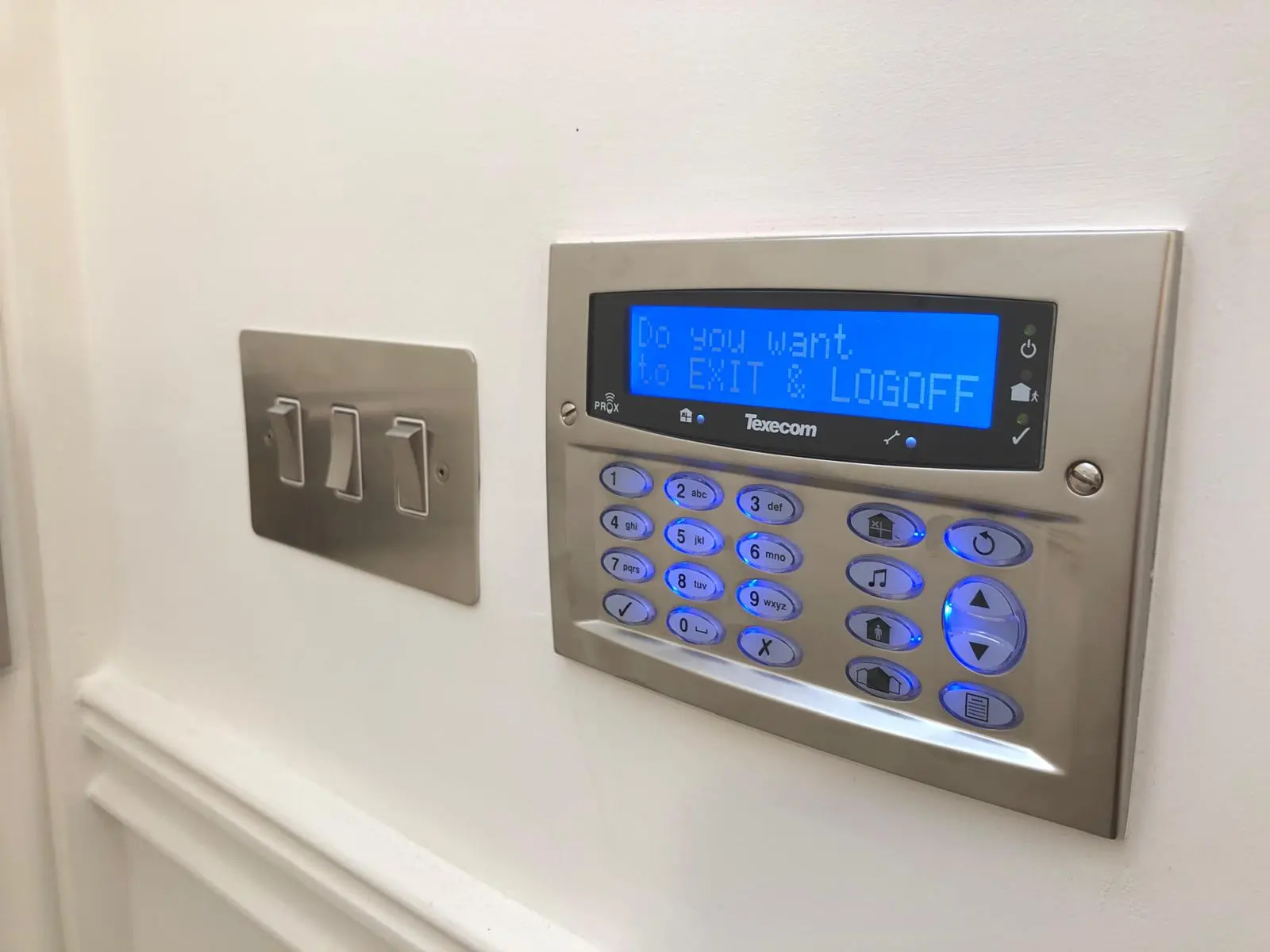
The alarm is detection and alerting. Our fire and security team installs Texecom, Ajax and Honeywell Galaxy intruder systems. The choice between them is usually about the building rather than preference: a wireless system suits a finished period property where nobody wants to chase walls, while a wired system suits a project that is open and has the cabling designed in. What matters in both cases is zoning, so a fault in one area does not arm or disarm the whole house.
Video Door Entry: Who Is There Before You Open
Door entry is a conversation and a decision. It lets you see and speak to a visitor at the gate or the front door, from a panel, a touchscreen or a phone, and then decide whether to release the door. On a country estate this is usually the gate post. In a London townhouse it is the front door and often a basement entrance as well. More detail on how we specify these systems is on our video door entry systems page.
Access Control: Who Can Go Where
Access control is the lock layer. We install Paxton systems to manage doors and gates by credential rather than by key, which is what makes a house workable for a family with staff, cleaners, a gardener and contractors. It also removes the weakest part of most security setups, which is a key that has been copied and never collected back.
Fire detection sits in the same team and on the same visits, using Advanced, Gent, Apollo and Hochiki equipment. It is a different discipline with different standards, but it shares the containment routes and the panel location, so it is coordinated in the same round of drawings rather than being an afterthought discovered on the last day.
The First-Fix Wiring That Is Expensive to Get Wrong
Security cabling is unglamorous and almost impossible to add later without damage. Three things are worth getting right while the building is open.
Structured Cabling to Camera Positions
Run CAT6 to every CCTV camera position, whether or not a camera is going there yet. That single cable carries both data and power for a Power-over-Ethernet camera, which means one discreet cable per camera and no separate mains spur to arrange. Where a position cannot take a cable, battery-powered cameras avoid the run entirely, but they are a fallback rather than a plan, because a battery camera has to be reached for servicing. Running the cable to a garden gate that might get a camera in three years costs very little at first fix and is disruptive to add once a drive has been finished.
Alarm Cabling to Sensors, Keypads and Sounders
Run two-core alarm cable of at least 0.5mm² to every PIR, door contact, keypad and siren. The common mistake is to run cable to the sensors and forget the places a person actually operates the system. A keypad inside the front door, a second at the kitchen or a side entrance, and a sounder that can be heard at the boundary all need planning, and all of them are effectively permanent once decorated around. Where a drawing shows a relocated door or a new partition, the cable route has to be re-agreed before plasterboard goes up, not after.
Why Alarm Cabling Belongs Off the Data Network
Keep alarm cabling separate from the data network for reliability. An alarm circuit and a data run are different jobs with different failure behaviour, and mixing them creates faults that are slow to diagnose because the symptom appears in one system and the cause sits in the other. Structure the network properly and the security traffic rides on it in its own segment, which is better practice anyway. Our home networking work covers the switching, coverage and segmentation that CCTV, door entry and alarm panels all depend on.
What Away Modes and One-Touch Scenes Actually Change
This is the part that sounds like marketing and is in fact the most practical thing on the page. When lighting, shading, audio and security are coordinated, leaving the house becomes one action instead of five.
An away mode does more than arm the alarm. It arms the security zones, closes the shading, sets the lighting to simulate occupancy so the house does not look empty from the street, and puts the audio and climate into their unoccupied state. At night, a single button arms the perimeter, keeps the bedroom landing light at a low level and leaves the interior sensors out of the picture so nobody sets the alarm off on the way to the kitchen.
The reverse matters as much. Arriving home disarms, opens the shading, brings the hallway and kitchen up to a sensible level and confirms the change on the touchscreen so you can see the system has actually done what you asked. These are small things individually. Together they are the difference between a house with technology in it and a house that behaves.
Because we programme in-house, and our Managing Director is also the Lead Programmer, these scenes are written by the same people who designed the system. Nothing is handed to a third-party programmer who never visited the property, which is the usual reason integrated systems end up doing less than they were sold as doing.
When a Large or Period Property Needs a Security Review
A house that has been quietly working for fifteen years is usually not the one that gets reviewed. The trigger is nearly always a change to the building or to how it is used.
A renovation or extension is the clearest one, because the balance of the property moves: a new rear extension becomes the obvious weak point, and glazing that did not exist before changes what the alarm can sensibly watch. Adding outbuildings, a garden office, an annexe or a garage with an internal door is another. A property that sits on a remote plot, or behind a gate, asks a different question again, because the entry point is no longer the front door.
Period properties bring their own list. Thick walls affect wireless propagation, listed status limits where you can fix and chase, and a building that has been extended in stages over a century rarely has a coherent cabling route through it. None of that makes security impossible. It does mean the survey has to be a real one rather than a fifteen-minute walk round.
We see this across the country estates in Surrey, Oxfordshire and the Cotswolds, where the house, the outbuildings and the gate are three separate problems that need one answer.
How a Project Runs, and What It Costs
Every project follows the same eight steps, starting with a first survey and finishing with handover. The order is deliberate. The survey informs the design, the design produces the drawings the electrician and builder work to, and the programming happens after installation when the property is quiet.
Most projects take eight to sixteen weeks depending on scope and the complexity of the property. Security is rarely the long pole on its own, but it is affected by everything else, because alarm devices, camera positions and door entry hardware all need to be agreed before first fix and commissioned after decoration.
On cost, the honest answer is that a survey and an itemised quote come before any work, and no responsible integrator will price a security system from a photograph. What we can give is the range the rest of the site already states. A focused apartment system covering lighting, audio and security typically starts from £8,000 to £25,000. Mid-size family home packages range from £25,000 to £75,000. Larger systems are quoted individually after a site survey, because at that scale the number follows the number of devices and zones rather than the size of the house.
What to Check Before You Appoint an Installer
One integrator or several trades is the first decision. Several trades can be cheaper on paper and is often the right answer for a small job. On a whole-house project it usually costs more in the end, because the coordination between alarm, network and control is the part that determines whether the systems talk to each other, and nobody is paid to own that coordination. One integrator has no one else to blame.
Then ask who programmes it and who maintains it. On an integrated system these are the same question. The programming is what makes an alarm event close the blinds and bring up a camera, and the person who wrote it is the person who can change it. If the answer involves a third party you have never met, expect every small change to become a project.
In-house programming is worth asking about directly. It is the difference between a system that does what the installer decided in advance and a system that can be adjusted to how your household actually lives a year later. It is also the reason we can be specific about what a scene will do rather than promising that it can be sorted later.
The last thing to check is whether the installer will still be answering the phone in five years, and whether they hold the documentation for your property. A security system is a fifteen-year commitment to a relationship, not a purchase.
If you are planning a project, or reviewing a system that no longer matches the house, our integrated home security systems page sets out what we install in more detail, and you can talk to us about a survey. The useful conversation happens before first fix, while the decisions are still cheap.
Planning Security Before First Fix?
A survey now will tell you where the cabling and the devices need to go, while those decisions are still cheap to make. We will talk through the property and come back with an itemised quote.
Vertex AV, Unit 7 Mowat Industrial Estate, Watford, WD24 7UY
+44 203 4880 530 | [email protected]