
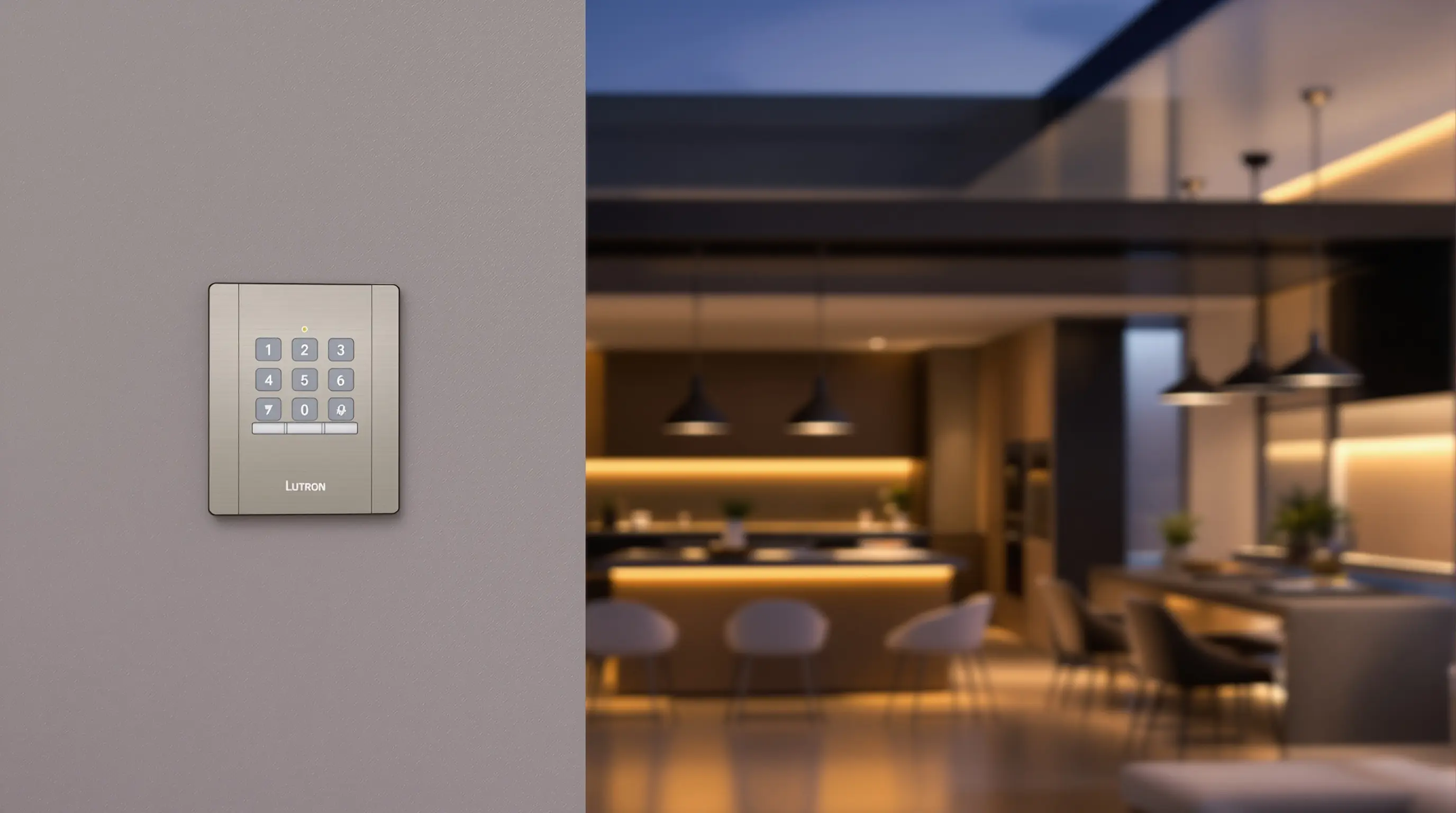
Lutron Lighting Control Explained: RA3 vs HomeWorks QSX
The systems, the costs and the lights worth pairing with them
Written by
Lighting Design Consultant & Lutron Specialist
Eleanor trained at the Royal College of Art before transitioning into architectural lighting design in 2012. She joined Vertex AV in 2019 to bridge the gap between interior design and technical automation. Eleanor is a Lutron Palladium Specifier, a Vantage InFusion certified designer, and holds the KNX Advanced certificate. She works directly with interior designers across Mayfair and Chelsea to ensure technology disappears into the architecture.
Walk through a recently completed luxury home in London or the Home Counties and there is a strong chance the lighting is controlled by Lutron. The American company has spent over sixty years refining how electric light behaves in architectural space, and its systems are specified by architects and interior designers more than any other brand. But Lutron does not sell one product. It sells two distinct platforms, RA3 and HomeWorks QSX, and choosing between them is the first decision every homeowner, architect or designer faces when planning a lighting scheme.
Vertex AV designs and installs Lutron systems across London, Hertfordshire and the Home Counties. We are a certified Lutron installer, and we also specify the luminaires themselves, Orluna in particular, which most competitors do not cover in a single piece of work. This article explains the difference between RA3 and HomeWorks QSX, what each platform costs installed in the UK, and why the light fittings matter as much as the control system that drives them.
What Lutron Lighting Control Actually Does
At its simplest, a Lutron system replaces every light switch in your home with a network of dimmers, keypads and a central processor that talks to them all. Instead of walking into a room and flicking three separate switches for the downlights, the wall washers and the table lamp, you press one button labelled "Evening" and the entire room settles into a pre-programmed scene: the downlights at 40%, the wall washers at 15% to highlight the artwork, the table lamp at a warm 60%. A single keypad by the door replaces a bank of four or five switches, and the result is visually cleaner, simpler to use and genuinely transformative in how a room feels at different times of day.
Beyond scenes, Lutron provides circuit-level dimming, meaning every individual light circuit is independently controllable. It integrates motorised shading, so blinds and curtains respond to the same scenes as the lights. It includes a timeclock that can simulate occupancy when you are away, bringing the lights on and off in a natural pattern that looks lived-in rather than robotic. And it gives you control from a smartphone app, a wall-mounted keypad, or a voice command, whichever feels natural at that moment.
It is worth distinguishing Lutron from consumer-grade smart bulbs. A Philips Hue or similar Wi-Fi bulb changes colour from your phone, but it relies on each bulb having its own radio, its own processor and a permanent live feed, and the light switch on the wall becomes a liability: if someone turns it off, the bulb goes offline. A Lutron system controls the circuit at the wall, just like a traditional dimmer, but with networked intelligence behind it. The dimmer is always powered, the keypad is always responsive, and the light fitting itself can be anything you choose, including the finest architectural downlights available. That last point is critical, and we will return to it.
Lutron RA3: The Sweet Spot for Most Homes
Lutron RA3 is the wireless, processor-based platform designed for the majority of residential projects. It supports up to 200 devices across two RA3 processors, which communicate using Clear Connect Type X, a proprietary wireless protocol operating in the sub-GHz band. Because it sits well below the 2.4 GHz and 5 GHz frequencies used by Wi-Fi, it is effectively immune to interference from routers, mesh networks and neighbouring wireless devices. This is not marketing; it is physics, and it is why RA3 feels as reliable as a wired system in practice.
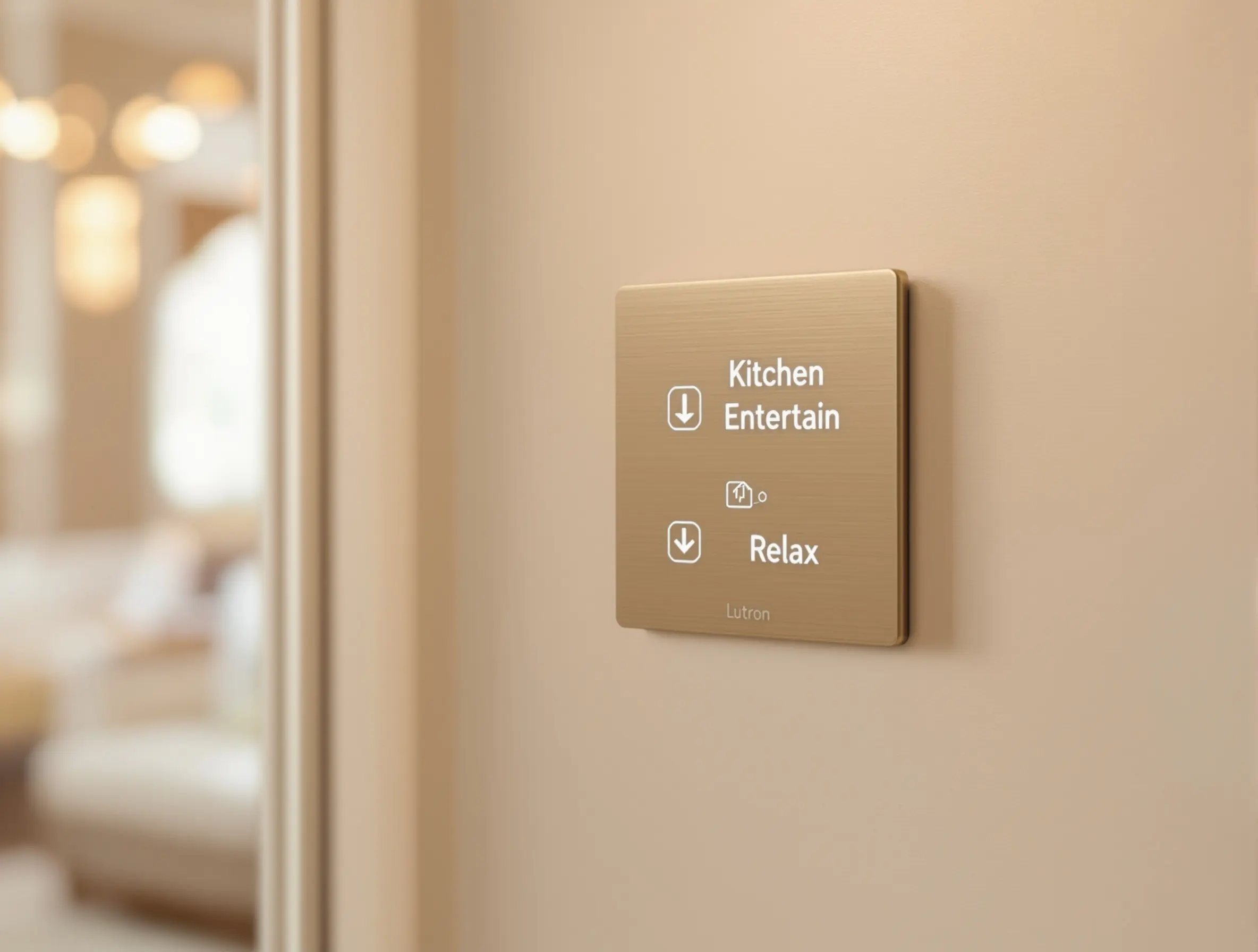
The keypad range for RA3 includes the Sunnata touch dimmer, a capacitive touch bar for dimming paired with a clean, minimalist faceplate, and the Palladiom keypad, Lutron's flagship architectural offering with a flush-mount design, no visible screws and backlit custom engraving that appears completely dark when the keypad is off. RA3 also supports the Lumaris tape lighting system for under-cabinet, cove and architectural accent applications. The aesthetic ceiling for RA3 is genuinely high: you can specify Palladiom keypads in brushed metal finishes with fully custom engraving and adjustable backlight colour temperature, and the result is indistinguishable from a HomeWorks installation at the keypad level.
RA3 does not require a central panel. The processor is a compact unit that sits in a cupboard or utility room, connected to the home network via Ethernet. The wireless dimmers fit into standard UK 35mm back boxes, which means an RA3 system can be retrofitted into an existing property with no structural alteration. This makes it the natural choice for renovations, apartments, leasehold properties where chasing walls is prohibited, and homes up to around four to six bedrooms where a wired infrastructure would be disproportionate.
RA3 also integrates with Control4 and Crestron automation systems. Lutron provides a certified driver for both platforms, so a RA3 lighting system can be triggered from a Control4 touchscreen, included in whole-home macros, and controlled alongside audio, video and security. For clients who want Lutron's lighting quality with Control4's whole-home intelligence, RA3 plus Control4 is a proven and cost-effective combination.
HomeWorks QSX: The Flagship
HomeWorks QSX is Lutron's top-tier residential platform. It is designed for large estates, new-build properties, major refurbishments and listed buildings where the lighting system is expected to last for decades. It supports up to 10,000 devices across wired and wireless communication, with dual QSX processors for redundancy, and it unlocks the full Lutron ecosystem: Ketra tunable lighting, Palladiom thermostats, Alisse keypads, and Sivoia QS shading with conditional logic and astronomical time clock integration.
The keypad offering for HomeWorks QSX is materially broader than RA3. In addition to Palladiom and Sunnata, QSX supports the Alisse keypad range, jewellery-grade hardware with concealed screw fixings, available in brushed and polished metals, leather, wood veneer, and custom colour matching to any RAL or Pantone reference. The Alisse range is specifically designed for period properties and heritage interiors where a contemporary Palladiom keypad would look visually incongruous. An Alisse keypad in antique brass beside an original Georgian door architrave does not announce itself as technology. It simply looks like it belongs.
Palladiom thermostats extend this unified design language to climate control. Instead of a white plastic thermostat from a different manufacturer breaking the visual consistency of a room, a Palladiom thermostat matches the keypads in finish, engraving style and backlight colour. For an interior designer, this is a significant detail: every wall-mounted control in the house shares the same material language, and the technology recedes into the architecture.
Ketra: The Headline Capability
Ketra is Lutron's premium tunable lighting ecosystem, and it is exclusive to HomeWorks QSX. Each Ketra LED fixture contains multiple colour channels capable of reproducing any colour temperature from 1,400K (candlelight) to 10,000K (blue sky), plus the full visible colour spectrum. The system tracks the time of day, your geographic location and the orientation of each room to automatically adjust colour temperature: cool, energising light in the morning that mimics natural daylight, shifting gradually to warm, relaxing light in the evening that supports the body's circadian rhythm.
Ketra can also reproduce the exact colour temperature and intensity of natural daylight at any time of day, making windowless rooms, basement gyms, cinema rooms and internal bathrooms feel naturally lit rather than artificially illuminated. For wellness-focused clients, art collectors who need precise colour rendering, or homeowners who simply want the most sophisticated lighting money can buy, Ketra is unmatched. The price premium is significant, typically adding £20,000–£50,000 to the lighting budget, but for the projects where it is specified, it is frequently the single most commented-on feature of the finished home.
A Note on HomeWorks QS
HomeWorks QSX supersedes the previous HomeWorks QS platform. If you have an existing QS system, it continues to function reliably and Lutron supports it, but any new project or substantial expansion should be specified on QSX. The current platform benefits from a faster processor, native Ketra support, improved wireless performance and compatibility with the latest keypad ranges. Our Kensington townhouse project was designed on HomeWorks QS, and we reference QSX as the current-generation equivalent for any client planning a similar installation today.
RA3 vs HomeWorks QSX at a Glance
A side-by-side comparison of the two platforms for homeowners, architects and designers researching which Lutron system suits their project.
| Feature | Lutron RA3 | HomeWorks QSX |
|---|---|---|
| Target Properties | Apartments, townhouses and family homes up to 4–6 bedrooms; renovations and phased projects | Large estates, new-build properties, listed buildings and whole-house projects of any scale |
| Device Capacity | Up to 200 devices across two processors | Up to 10,000 devices; effectively unlimited |
| Communication | Wireless only (Clear Connect Type X, sub-GHz) | Wired and wireless for absolute reliability |
| Wiring Topology | No central panel required; works with existing back boxes | Panelised or distributed; processors in a central rack |
| Keypad Ranges | Sunnata touch dimmers and hybrid keypads, Palladiom keypads | Palladiom, Alisse (jewellery-grade hardware), Sunnata |
| Ketra Tunable Lighting | Not supported | Full support; exclusive to HomeWorks QSX |
| Motorised Shading | Sivoia QS wireless shades, up to 100 devices | Sivoia QS wired and wireless, astronomical time clock, conditional logic |
| Keypad Materials | Plastic and metal finishes, custom engraving | Brushed and polished metals, leather, wood, custom RAL colour matching |
| Palladiom Thermostats | Not supported | Full integration for a single design language across the home |
| Typical Project | Retrofit apartment in Mayfair, four-bedroom family home in St Albans | New-build estate in Hertfordshire, Grade II listed manor in the Cotswolds |
| Typical Installed Budget | £8,000–£25,000 | £25,000–£150,000+ |
Lutron RA3
HomeWorks QSX
The Lights Matter as Much as the Control: Why We Specify Orluna
Here is an uncomfortable truth that the lighting control industry does not say loudly enough: a £30,000 Lutron system dimming cheap downlights still looks cheap. Poor-quality LED drivers flicker at low dimming levels, produce an audible buzz, and exhibit dead travel, the infuriating gap where nothing happens for the first 20% of the dimmer's range, followed by a sudden jump. The driver and the dimmer must be engineered to work together, and the light engine inside the fitting determines the quality of what you actually see. The control system is the conductor. The luminaire is the instrument. You need both to be excellent, or the result is mediocre.
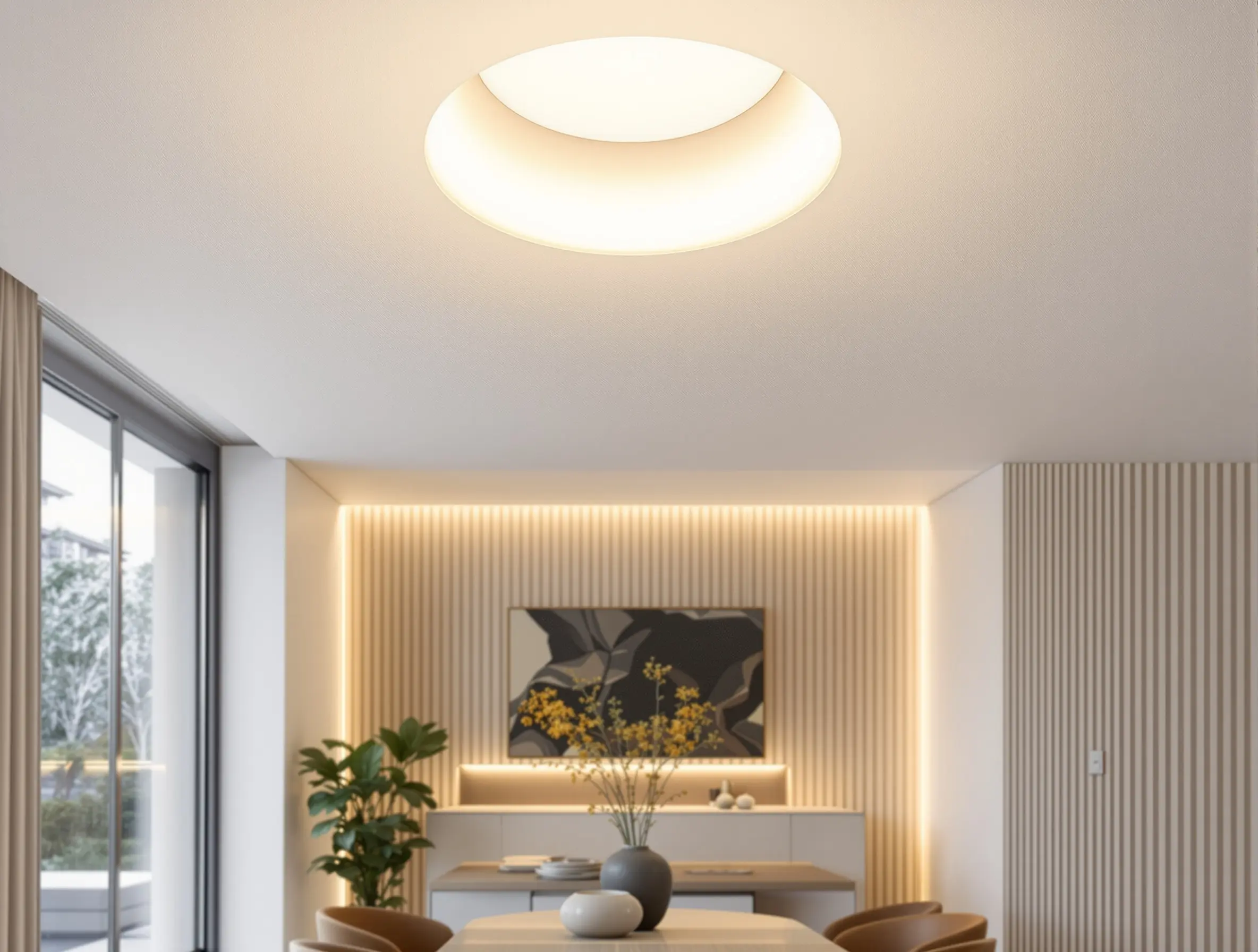
This is why we specify Orluna as our default architectural downlight alongside Lutron control. Orluna is a British manufacturer producing downlights in the UK, and the specification is exceptional: 98 CRI (Colour Rendering Index) as standard, which means colours under an Orluna fitting look essentially identical to how they look under natural daylight. Ten beam angles are available per fitting, from a tight 15-degree accent spot to a wide 60-degree flood. The range includes trimless options that are plastered into the ceiling and become completely invisible when off, and low-glare options with deep baffles for home cinemas and media rooms where any visible light source would be a distraction.
The Origin Light Engines
Orluna offers three Origin LED light engines, and choosing the right one for each room is where the lighting design process earns its value. Origin is the standard engine, delivering a fixed colour temperature with 98 CRI, superb for general living spaces, kitchens and bathrooms. Origin Natural pushes colour rendering to near-perfect, the closest LED approximation of natural daylight currently available from a downlight. It is the choice for art collections, dressing rooms, and spaces where colour accuracy is non-negotiable.
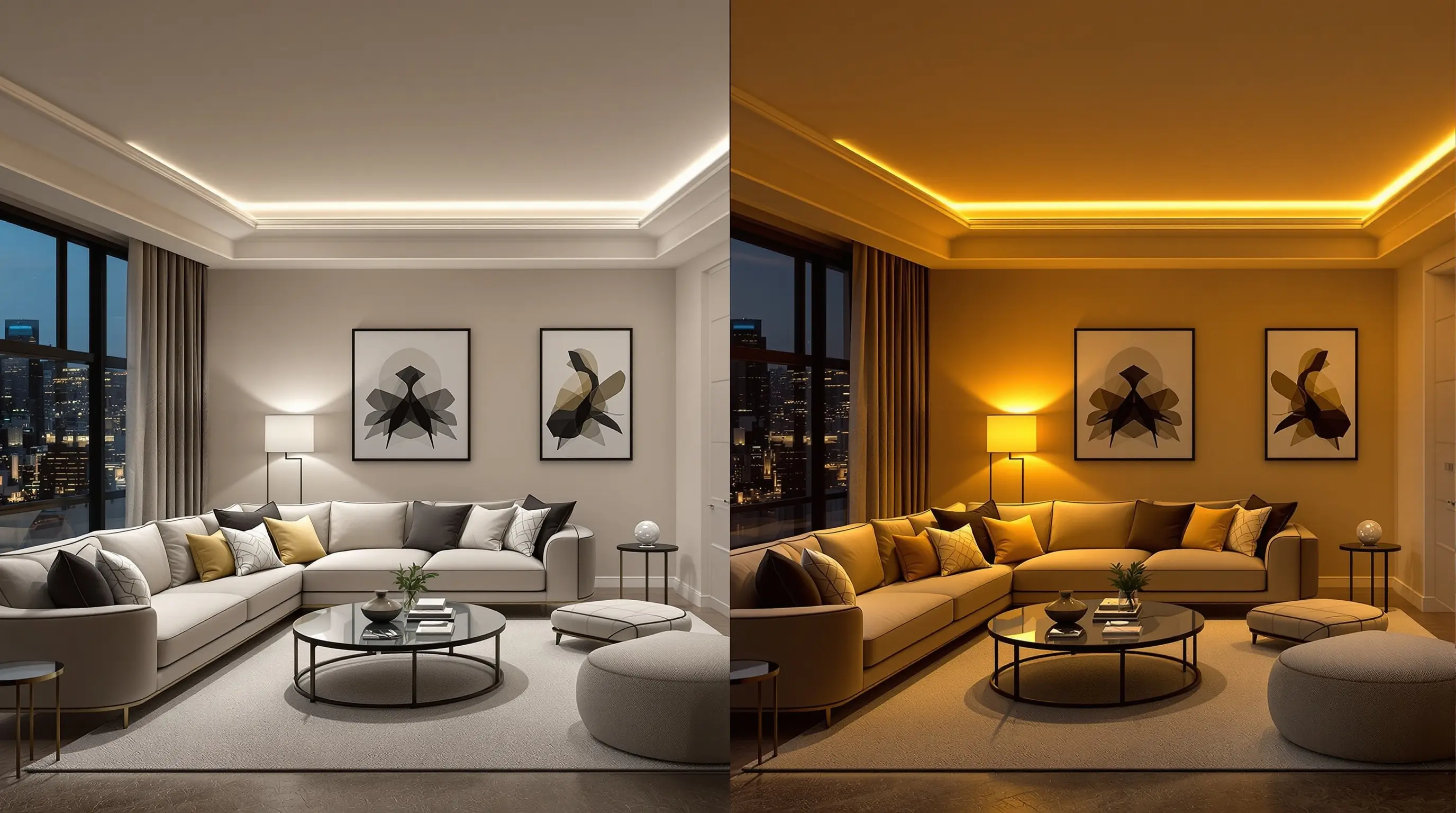
Origin Warm Dim is the engine we specify most often for living rooms, dining rooms and bedrooms. It starts at 3000K at full brightness, a clean, natural warm white, and as you dim it, the colour temperature shifts: 2700K at 50%, 2200K at 20%, and down to a candlelit 1800K at the bottom of the dimming curve. The effect is not "the room gets darker." It is "the room gets warmer." An evening dining scene with Origin Warm Dim downlights, Lutron dimmers, and a Palladiom keypad labelled "Dinner" creates a glow that genuinely feels like candlelight. This is the combination clients comment on most after living with the system for a few weeks. It is not a technical feature they researched. It is something they feel.
The Ranges
Orluna's range covers every architectural application. One is the near-invisible trimless downlight with no face detailing, designed to disappear into the ceiling plane. Dino features a low-glare black baffle, ideal for home cinemas and media rooms. Curve and Fade offer decorative visible options where the fitting itself is part of the design language. Twin and trimless variants are available across the range, and IP-rated options cover bathrooms, shower rooms and pool houses with no compromise on the light quality.
A practical note on specification: the LED driver and dimming protocol, forward-phase or reverse-phase, must be matched to the Lutron load schedule at the design stage. This is exactly the coordination a professional integrator provides and a supplier or electrician ordering fittings online generally does not. Get it wrong, and the £200 downlight flickers or buzzes and the client blames the control system rather than the incompatibility. At Vertex AV we specify both the control and the luminaires, so the driver, the dimmer and the light engine are designed as a single system from the start.
What Does Lutron Cost Installed in the UK?
Honest pricing, because the lighting control industry has been evasive about this for too long. These are the installed bands we quote at Vertex AV, drawn from real projects across London and the Home Counties. Every figure includes the hardware, the design, the installation by our NICEIC-approved team, and the Lutron programming and commissioning.
Lutron RA3
£8,000 – £25,000A complete wireless lighting control system for a renovation or partial-house project. Covers a processor, typically eight to eighteen lighting circuits with dimming, four to six designer keypads, the Lutron app for control, and professional design, installation and programming. Ideal for apartments, townhouses and medium-sized family homes.
HomeWorks QSX (Entry)
£25,000 – £60,000The entry point for a whole-home Lutron HomeWorks QSX installation in a four to five-bedroom property. Includes a QSX processor, wired and wireless infrastructure, twenty to thirty-five lighting circuits, eight to twelve designer keypads, Sivoia shading on key windows, and full scene programming. The level where the home begins to feel genuinely intelligent.
HomeWorks QSX (Whole-House)
£60,000 – £150,000+A comprehensive HomeWorks QSX installation for a large estate or new-build property. Dual processors for redundancy, forty to eighty-plus lighting circuits, designer keypads in every room, Sivoia shading throughout, Ketra tunable lighting in principal spaces, Palladiom thermostats and full integration with Control4 or Crestron. The finest residential lighting control available.
Orluna Fittings: A Separate Budget Line
Orluna downlights are priced per fitting and sit outside the Lutron control budget. As a guide, expect £180–£350 per fitting for the standard range, rising to £300–£550 for Origin Natural or Origin Warm Dim engines in trimless variants. A kitchen with twelve Orluna One trimless Origin Warm Dim downlights would add approximately £3,500–£5,500 to the lighting budget, independent of the Lutron control system. The value is in what you see and feel, not in the specification sheet, and for clients who care about light quality, Orluna is one of the most cost-effective upgrades in the entire project.
What Moves the Number
The difference between a £10,000 RA3 system and a £100,000 HomeWorks QSX installation comes down to a handful of variables. Circuit count is the baseline: more lighting circuits mean more dimming modules, more cable runs and more programming. Keypad specification is the single biggest aesthetic cost driver; a Sunnata keypad at £150 and a Palladiom keypad in hand-polished nickel with custom engraving at £400 look and feel like different categories of object. Shading adds substantially: Sivoia QS motors, fabric and programming cost £800–£2,000 per window, and across a house with twenty windows, that is £16,000–£40,000 in shading alone. Ketra tunable lighting is the largest single premium, adding £20,000–£50,000 to a HomeWorks QSX project, but delivering a lighting experience that no other residential system can replicate.
Every project is priced individually from a proper lighting design. If you would like an itemised quotation for your property, book a free site survey and we will visit, assess your home, and provide a detailed breakdown with no obligation.
Which System Is Right for Your Project?
Four common scenarios, drawn from our work across London and the Home Counties.
London Apartment Retrofit
Mayfair, Kensington or Chelsea
A two-bedroom leasehold apartment in a period conversion where chasing walls is impossible. Lutron RA3 uses Clear Connect Type X wireless communication, no central panel required, and the wireless dimmers fit into existing 35mm back boxes. A Sunnyata keypad by the entrance, Palladiom keypads in the living room and master bedroom, and six to ten circuits of dimmed lighting controlled from the Lutron app. The entire installation is completed with zero structural disruption and typically costs £10,000–£18,000. If you later move to a larger property, the RA3 system can be expanded or migrated as a phased upgrade.
Hertfordshire New Build
St Albans, Harpenden or Radlett
A five-bedroom new-build family home with an open-plan kitchen, a cinema room and a large garden. HomeWorks QSX is specified from the architect drawings, with a QSX processor in the utility room rack, thirty to forty lighting circuits across the property, Palladiom keypads in brushed titanium throughout the ground floor, and Alisse keypads in a softer finish for the bedrooms. Sivoia QS blackout blinds in all bedrooms track the sun automatically. The system is integrated into a Control4 processor for whole-home orchestration, audio, video, climate and security in one interface. Installed cost for the Lutron element: £35,000–£55,000.
Period or Listed Property
Hampstead, the Cotswolds or Oxfordshire
A Grade II listed Georgian rectory or Victorian villa where visible technology would compromise the architecture. HomeWorks QSX provides panelised lighting control with processors hidden in a basement rack. Alisse keypads in antique brass or heritage bronze sit discreetly beside original door architraves. Orluna One trimless downlights are plastered into the ceiling, completely invisible when off, with Origin Warm Dim engines that shift from 3000K to a candlelight 1800K as they dim. The effect in a period dining room with original cornicing is transformative: warm, atmospheric and entirely sympathetic to the building. A QSX system of this nature, with twenty-five to forty circuits and trimless Orluna throughout, typically costs £45,000–£85,000 for the lighting and control.
Phased Project
Starting with Key Rooms
A family undertaking a renovation in stages: the ground floor this year, the first floor next year, the garden room the year after. Lutron RA3 is the natural choice. Start with a single processor covering the kitchen, dining room and living room with eight to twelve circuits and three to four keypads for approximately £12,000–£18,000. In phase two, add a second RA3 processor to bring the bedrooms and landing into the system. The processors communicate wirelessly, so there is no need to run cables between phases. When the project is complete, the system is a single, unified Lutron installation with the same keypad aesthetics in every room. If the project grows beyond 200 devices, HomeWorks QSX is the natural upgrade path, and your RA3 keypads and dimmers are compatible with the QSX platform, protecting your phase-one investment.
Lutron & Orluna FAQs
What is the difference between Lutron RA3 and HomeWorks QSX?
Lutron RA3 is a wireless lighting control platform designed for apartments, townhouses and medium-sized family homes, supporting up to 200 devices across two processors. It uses Clear Connect Type X wireless communication, requires no central panel, and works with existing back boxes, making it ideal for retrofit projects. HomeWorks QSX is Lutron's flagship platform for large estates and high-end new builds, supporting up to 10,000 devices across wired and wireless communication. It unlocks the full Ketra tunable lighting ecosystem, Palladiom thermostats, processor redundancy, and conditional logic programming. RA3 is the platform for most homes. HomeWorks QSX is the platform for homes where lighting is treated as architecture. At Vertex AV we install both and help you choose the right one for your project.
How much does Lutron cost installed in the UK?
Lutron RA3 starts from approximately £8,000 for a focused system covering eight to twelve lighting circuits in a two-bedroom apartment, rising to £25,000 for a comprehensive whole-home system. Lutron HomeWorks QSX begins around £25,000 for a mid-sized property and frequently exceeds £60,000; a full QSX installation with Ketra tunable lighting and Sivoia shading throughout a large estate can reach £150,000 or more. Several factors move the number significantly: circuit count, keypad specification (Sunnata versus Palladiom versus Alisse), whether motorised shading is included, and whether Ketra tunable lighting is specified. Every project is priced individually from a proper lighting design, which is why we provide a free, no-obligation site survey before quoting.
Can Lutron RA3 be retrofitted without rewiring?
Yes. Lutron RA3 is specifically engineered for retrofit installations. The wireless dimmers communicate via Clear Connect Type X, a proprietary sub-GHz protocol that is immune to Wi-Fi interference, and fit into standard UK 35mm back boxes. There is no central panel to accommodate and no new cabling to run. The RA3 processor is a compact unit that can be placed in a cupboard or utility room and connected to the home network via Ethernet. For leasehold apartments, period conversions and occupied homes where structural alteration is undesirable or impossible, RA3 delivers genuine Lutron lighting control with zero disruption to the fabric of the building. We have completed RA3 retrofits in Grade II listed properties in Hampstead and leasehold apartments in Mayfair where chasing walls was not an option.
Do Orluna downlights work with Lutron?
Yes, and this is a combination we specify routinely at Vertex AV. Orluna downlights use LED drivers that are specifically tested for compatibility with Lutron RA3 and HomeWorks QSX dimming modules. The key is specifying the correct driver and dimming protocol at the design stage: forward-phase or reverse-phase, matched to the Lutron load schedule. This is the coordination an experienced integrator provides, and it is the reason we handle both the control system and the luminaire specification in-house. A homeowner or electrician ordering fittings online without verifying driver compatibility will frequently encounter flicker, dead travel at low dimming levels, or drop-out. When Orluna Origin Warm Dim engines are paired with Lutron adaptive phase dimmers, the result is smooth, silent dimming from 100% down to a candlelit glow at 1800K, with no flicker and no audible buzz.
Is HomeWorks QSX the replacement for HomeWorks QS?
Yes. HomeWorks QSX is the current-generation platform that supersedes the previous HomeWorks QS. It brings a faster processor, native support for the Ketra tunable lighting ecosystem, improved wireless performance with Clear Connect Type X, and compatibility with the latest Palladiom and Alisse keypad ranges. If you have an existing HomeWorks QS system, it continues to function reliably and Lutron supports it, but any new project or major expansion should be specified on the QSX platform to benefit from the current hardware, the broader device ecosystem and the longest possible manufacturer support window. At Vertex AV we can assess an existing QS installation and advise on the most cost-effective upgrade path, whether that means a phased migration to QSX or expanding the current QS system with compatible hardware.
Do I need a lighting designer as well as an installer?
Not necessarily, and this is one of the benefits of working with an integrator who bridges both disciplines. At Vertex AV, Eleanor Vance is both a Lutron Palladiom Specifier and an experienced lighting design consultant. She produces the lighting plan, specifies the luminaires and the control system, and then our NICEIC-approved installation team carries out the physical installation and commissioning. Everything stays under one roof, which means the lighting design, the driver specification, the dimming protocol and the Lutron programming are coordinated from a single point of responsibility. For larger projects where an independent lighting designer is already appointed, we work collaboratively: the designer defines the lighting concept and the luminaire schedule, and we handle the technical specification, Lutron programming and installation. Both approaches work. The critical thing is that the control system and the light fittings are specified together, not separately.
Resources & References
Book a Lighting Design Consultation
Speak with Eleanor Vance, our Lutron Palladiom Specifier. We will visit your property, understand how you want each room to feel, and design a Lutron lighting scheme with Orluna luminaires that is genuinely right for your home. No brand bias, no sales pressure, and no obligation.